
Est.1985

Environmental Lecture Series

Winter Semester 2026/27

Burn, Baby, Burn: Fueling the Climate Crisis

What does it mean to live on a planet that is quite literally burning — and what does it mean when we are the ones fuelling the flames? Why do wildfires and heatwaves keep breaking records year after year, and what do they reveal about the energy systems we’ve built to power our lives? Who is most exposed to extreme heat and burning landscapes, and what would it take to move beyond the fuels driving this crisis? 

Fire and heat connect to a set of urgent, interlocking problems. Understanding these challenges also means recognizing fire as a natural force that shapes ecosystems and societies, from wildfires and peatland fires to controlled burning and traditional fire management. But the conditions under which fire occurs are changing. Human-driven climate change is altering where, when, and how intensely fires burn, while heatwaves, marine heatwaves, and rising urban temperatures increasingly affect people, agriculture, and ecosystems. At the same time, human activities are changing the balance and adding fuel to a warming world: burning fossil fuels, extracting resources, heating buildings, transporting people, producing and discarding goods, and transforming landscapes. These connections raise broader questions about energy, consumption, justice, land use, and how humans can learn to live with fire in a changing climate. 

The lecture series “Burn, Baby, Burn: Fueling the Climate Crisis” invites you to explore these connections through diverse perspectives and expertise. Each week, speakers from science, industry, policy, and civil society will share insights into the flames we can see and the systems that feed them. Throughout the series, interactive discussions will create space to reflect on energy transitions, resilience, and accountability, and to ask what it takes to cool down a planet that keeps heating up.

For TUM students interested in earning 1 or 3 ECTS credits

For everybody else

In our introductory session, you will:

  • Meet our team
  • Get an overview of our course and lecture structure
  • Try out our Engagement Lab
  • and have the space to ask any questions you may have

We will conclude the session with a 30-minute documentary from our partner organization, Dok.fest
 

Climate Change and Fire Ecology in Florida: Prescribed Fire, Wildfire, and the Future of Fire-Adapted Ecosystems
 
Fire has shaped Florida’s landscapes for thousands of years, maintaining the ecological structure and biodiversity of Florida’s forests. Resilience of many of these fire-adapted ecosystems, including the longleaf pine savannas, flatwoods, and scrub habitats rely on particular fire intervals associated with their needs. With climate change altering the environmental conditions under which fire occurs, there are wide ranging implications for impacts on fire behavior, increased wildfire risk, and it makes prescribed burning for ecosystem health much more difficult to implement. This talk will explore the ecological role of fire in Florida, highlighting the importance of prescribed burning as a management tool for maintaining biodiversity and reducing hazardous fuel accumulation, while supporting overall ecosystem resilience. It will also examine how changing temperature and precipitation patterns have caused increasing droughts that influence wildfire activity and complicate prescribed fire management. Particular attention will be given to the balance between the ecological benefits of fire and the risks posed by increasingly challenging fire-weather conditions, as well as the role of land managers in adapting fire practices to a changing climate. By integrating principles of fire ecology, climate science, and land management, this talk will consider strategies for sustaining Florida’s fire-adapted ecosystems while reducing wildfire threats and supporting long-term ecological resilience.
 
Alexander Fine is a Park Service Specialist with the Florida Forest Service at Goethe State Forest near Dunnellon, Florida. His work encompasses a variety of forestry and land management activities, including prescribed fire operations and wildfire response. He is also a graduate student at the University of Florida, where he is pursuing a Master of Science in Forest Resources and Conservation with a concentration in Ecological Restoration. His graduate studies are complemented by certificates in Forest Health and Resilience and Natural Resource Policy and Administration. He has also completed the Certificate in Natural Areas Management through the University of Florida’s Natural Areas Training Academy, and the Florida Forest Service’s Certified Prescribed Burn Manager Training.


Professor Dr. Dr. h.c. mult. Johann Georg Goldammer is Chief of the Global Fire Monitoring Center (GFMC), which he founded in 1998 at the Max Planck Institute for Chemistry, based at the University of Freiburg, Germany, where he also serves as a professor of fire ecology. With its nine branches (Regional Fire Monitoring / Fire Management Resource Centers), which have been established globally since 2010, the GFMC is serving the Science-Policy-Practitioners Interface (SPPI) and provides scientific-technical advisory support to countries, the United Nations family – notably the Global Fire Management Hub – and multilateral/intergovernmental organizations for developing policies and capacities in Integrated Landscape Fire Management. In Europe, GFMC is serving the European and Mediterranean Major Hazards Agreement of the Council of Europe and the Organization for Security and Cooperation in Europe (OSCE).

TBA 

Participating in this activity grants attendance points as in the usual lectures

 Climate change has strong impacts on plants, animals, fungi and other living beings. It does not only affect individual organisms, but subsequently also populations, interactions amongst species, and thus entire ecosystems. With ongoing climate change, environments change in ways that are unfamiliar to organisms: Ecological novelty is on the rise. This means that the conventional goals of nature conservation and ecological restoration, which were to conserve and restore historical species compositions, are becoming obsolete. Traditional approaches to environmental management thus are called into question, and the big questions are: Which nature is it that we want to conserve and restore? Given ongoing climate change, what are our best options for halting the loss of biodiversity and setting a course toward a nature-positive future? 

Tina Heger is an ecologist focusing on knowledge synthesis and conceptual research on global change effects and nature conservation. Together with colleagues, she developed the concept of “ecological novelty” for describing states in nature that have no historic analog. In her current research, she is teaming up with computer scientists, philosophers and others to work towards a digital “atlas of knowledge” in which scientific knowledge would be accessible in an actionable form at no cost. She was recently awarded an adjunct professorship at Technical University of Munich, and a honorary professorship at Leuphana University Lüneburg.  


Shared Session with WEF Global Shapers Munich Hub

The Climate Café is a monthly community panel that brings together people interested in discussing climate challenges and exploring ways to create impact locally and globally. As the community grows, it fosters momentum for environmental action and offers a safe, collaborative space for sharing ideas and taking concrete steps together.

The Global Shapers community, an initiative of the World Economic Forum, is a network of hubs developed and led by young people who are exceptional in their potential, their achievements, and their drive to make a contribution to their communities.

📍 TUM Think Tank, Richard-Wagner-Straße 1, 80333 München
🌐 Google Meet: https://meet.google.com/hxy-gazf-vdz

Participating in this activity grants attendance points as in the usual lectures

shared Session with the Hochschule München University of Applied Sciences

Location: Hörsaal „Roter Würfel“ R 1.046 (Lothstr. 64) | Online: Zoom

The Lectures for Future is a public lecture series at Hochschule München University of Applied Sciences, held every semester in a hybrid format. Moderated by Prof. Dr. Christian Holler and Prof. Dr. Heinz P. Huber, it brings together researchers from Munich’s universities to explore climate change, environmental protection, and sustainability from diverse interdisciplinary perspectives.

Participating in this activity grants attendance points, as in the usual lectures

TBA

Documentary screening in collaboration with DOK.fest – DOK.fest is the largest film festival in Germany dedicated solely to documentaries. Every year in May, the DOK.fest welcomes well over 100 films, their makers, and, if possible, some protagonists in Munich. They screen at over 20 locations throughout the city and beyond. Since 2020, there has been a digital platform too, that offers these films to be enjoyed, discussed, or binged at homes throughout Germany. Celebrating excellence in the documentary cinematic art is as important to the Dok.fest as are the discoveries, discussions, and encounters for the guests and the audiences. The Student Award of DOK.fest München presents outstanding documentary films by students of German-speaking film schools.

Participating in this activity grants attendance points as in the usual lectures


Shared Session with the Hochschule München University of Applied Sciences

Location: TBA

The Lectures for Future is a public lecture series at Hochschule München University of Applied Sciences, held every semester in a hybrid format. Moderated by Prof. Dr. Christian Holler and Prof. Dr. Heinz P. Huber, it brings together researchers from Munich’s universities to explore climate change, environmental protection, and sustainability from diverse interdisciplinary perspectives.

More details on this talk will be announced soon.

Participating in this activity grants attendance points as in the usual lectures

TBA

RCE BenE Munich: “Education is the key to a sustainable world”. RCE BenE München e.V. stands for Education for Sustainable Development and is the regional competence center for ESD. We implement educational projects with schools, universities, and in adult education. In our working groups, we give citizens the opportunity to actively participate in sustainable and regenerative development and network with people interested in ESD. The RCE BenE Munich works primarily locally/regionally, but is very well networked nationally and internationally! Focus of content:
– Education for sustainable development (ESD)
– Agenda 2030 / SDGs
– Sustainability
– Shaping regenerative cultures

Tours are conducted in English and offered free of charge.  Participating in this activity grants attendance points as in the usual lectures. Only 20 places are available per excursion. To register, please send an email to: info@bene-muenchen.de

Meeting point: TBA

Shared Session with Protect the Planet

TBA

Participating in this activity grants attendance points as in the usual lectures

getting to the lecture hall

Location

On-site: TUM Main Campus

Room: N1190 (Hans-Heinrich-Meinke-Hörsaal)

Floor: 2
Building: U-Trakt (N1) (Nordgelände)
Location: Theresienstr. 90, 80333 München

Microsoft Teams Session

Webinar ID: 370 842 304 143 054 0
Password: xH6u2VF9

Contact us!

rivo@fs.tum.de

History of the Environmental Lecture Series

The lecture series on the environment is an interdisciplinary, public lecture series organised by the Environmental Department of the Student Union of the TU Munich. It is organised by TU Munich students on a voluntary basis.

Speakers have been giving lectures on the topic of sustainability since 1985. This includes, for example, technical environmental protection, health, consumer and climate protection. In this way, it offers both students and teachers at the TU Munich, as well as the non-university public, the opportunity to learn about and discuss these topics and research results at a scientific level.

The speakers from research, associations, authorities and companies will be happy to answer questions from the audience after the lecture; the slides of the lectures, and in some cases the video recordings themselves, will be made available – if available – on our website. In the 40 years of its existence, more than 480 lectures have been organised so far.

In the meantime, the lecture series on the environment has become a regular part of the TU’s lecture programme and is supported, among others, by the management of the TU Munich, the Munich Center for Technology in Society and the KHG of the TU Munich. The lecture series on the environment is a partner of the BNB, the “Alliance for Sustainability in Bavaria”. In addition, some lectures are held in cooperation with the Environmental Academy and the Munich Forum for Sustainability.

Check out our trailer! 😉

“As Vice President of TUM, I am proud to endorse the Environmental Lecture Series, RiVo. For nearly 40 years, TUM students have been at the forefront of this interdisciplinary initiative, providing a platform for knowledge exchange and facilitating critical discussions on the challenges and solutions surrounding sustainability. It is heartening to see speakers from diverse backgrounds sharing their expertise and enriching our understanding. RiVo educates, raises awareness and inspires action for a greener future. My heartfelt appreciation goes to the Student Council’s Environmental Department for their tireless dedication in organizing this invaluable series.“

Prof. Dr. Werner Lang
TUM Vice President for Sustainable Transformation

Our previous lecture series

Watch our previous recorded lectures here!

poster_rivo_ws2526
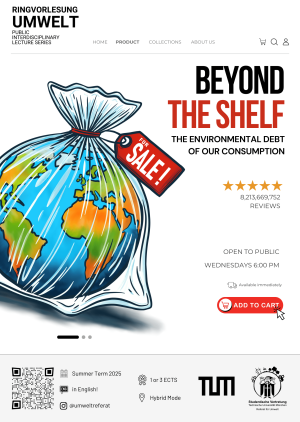
Beyond the shelf
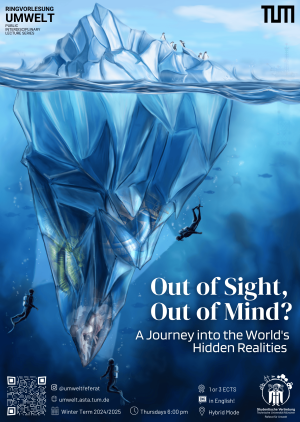
rivo_ws24_poster_2mb
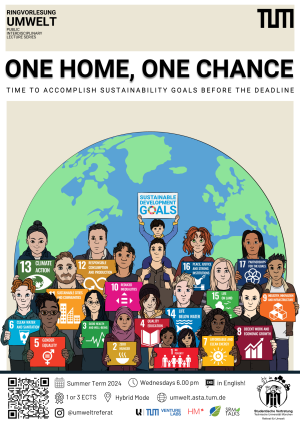
Outdoor Poster (60 × 84.7 cm)2
Poster
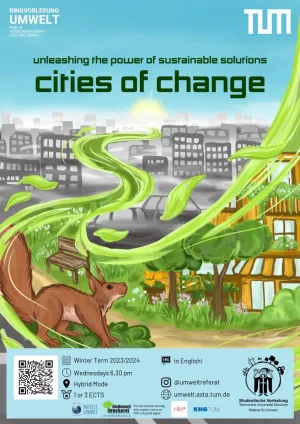
RiVo SS23 Poster